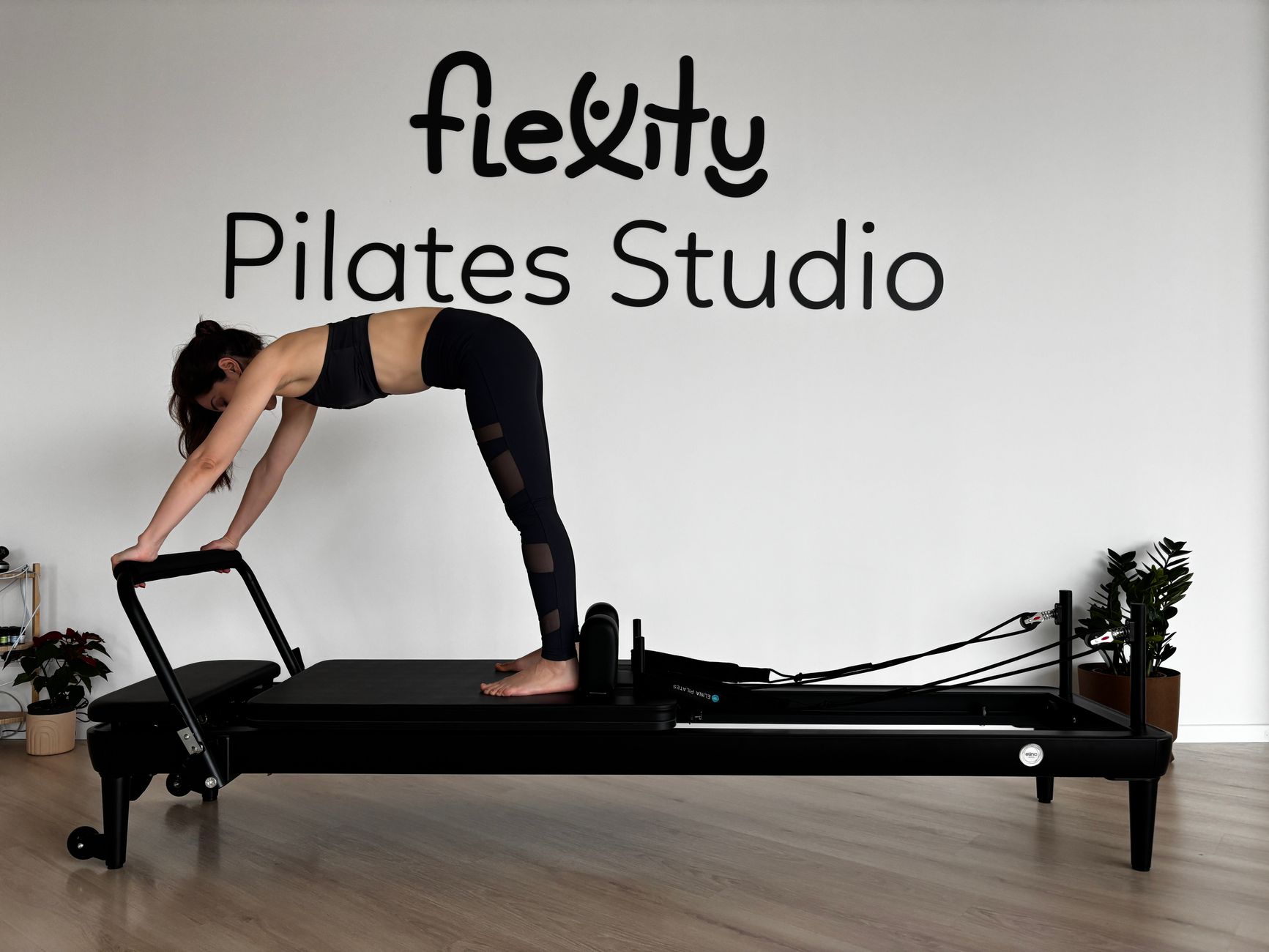
Most people point to the middle of the back of the thigh when they say their hamstrings are tight. When I ask them to show me where it grabs in Spine Stretch Forward, the hand drifts higher, toward the fold under the glute. That is the sit bone, and it is where all three hamstrings originate.
This matters because a stretch aimed at the muscle belly and a stretch that loads the tendon near its attachment are different experiences. Pulling hard on a straight leg in a forward fold tends to put the most tension right at that origin. Some people end up with a sore, nagging spot there that never quite resolves, and they respond by stretching harder. In my observation, that is usually the wrong response.

The hamstrings cross both the hip and the knee, so they are working in nearly every leg-heavy exercise we teach. In Roll Over, they are asked to control the legs as they travel overhead and back down. In Leg Pull Back, they help hold the hips up alongside the glutes. Even Footwork on the Reformer, with heels on the bar, asks them to work as the carriage returns.
A hamstring that gets used this way is not a hamstring that needs to be yanked longer. It needs to be strong through its range.
When someone arrives with a cranky sit bone, I change a few things before I change the exercise list:
- Bend the knees slightly in Spine Stretch Forward and ask for the curve to come from the spine, not from hanging off the back of the leg.
- Slow the descent in Roll Over so the legs are controlled rather than dropped.
- Check that the pelvis is not tucking and sliding into the sit bones during seated work. Sitting directly on that tendon for long stretches does not help it.
None of this is a medical protocol, and persistent pain near the sit bone is worth having a doctor or physical therapist look at. But as a movement teacher, I will say plainly that the instinct to treat every pulling sensation as a flexibility problem has sent a lot of people in the wrong direction.
The next time the back of your leg feels tight, put a finger where the thigh meets the glute and notice whether that is where the sensation actually is.