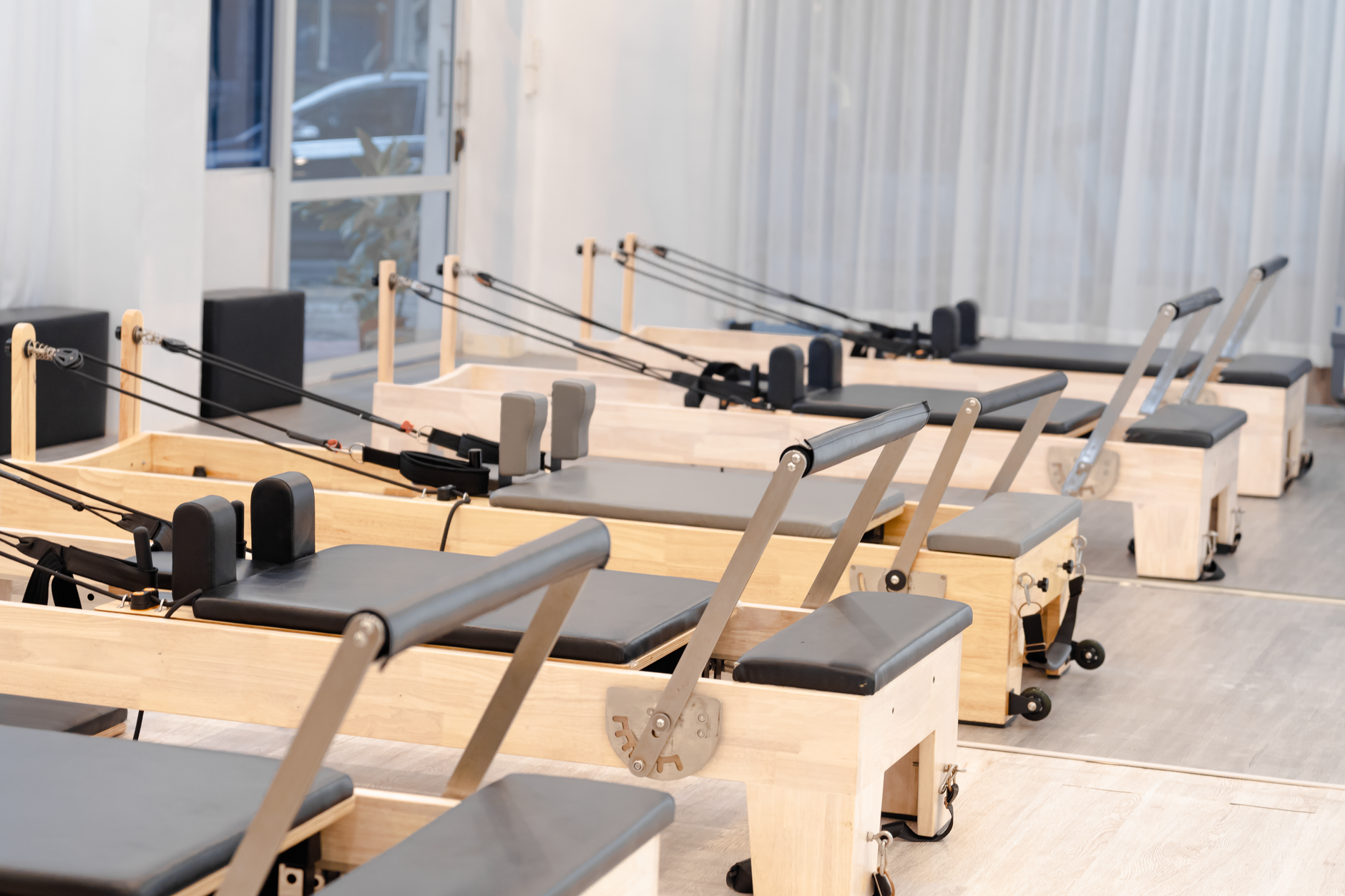
The long box sits on the Reformer and looks passive. It’s a flat surface, a place to lie down, a change from standing or kneeling. New students often visibly relax when they see it. That relaxation is exactly what the long box is designed to interrupt.
When you’re standing or sitting, the floor and the chair give you information. Your feet push back. The seat catches your weight. The long box gives you none of that. You’re prone, suspended, and responsible for everything — and the carriage beneath you will move the moment you stop organizing yourself.
Pulling Straps
Pulling Straps is where the long box announces itself. You lie face-down, arms forward, holding the straps. The cue is to pull the arms back toward the hips while lifting the chest - a simultaneous demand on the posterior chain and the thoracic extensors.
Most people default immediately to the lumbar spine. The low back arches, the glutes grip, the upper back barely moves. This is not an error in effort; it’s an accurate readout of what’s actually mobile and what isn’t. The long box just makes it visible.
The exercise is asking for thoracic extension - the kind that lifts the sternum away from the box rather than simply compressing the lumbar vertebrae. That distinction matters. When thoracic mobility is limited, the body borrows from wherever it can. The long box keeps a precise accounting of that debt.
T-Pull and What It Reveals About the Shoulder Girdle
T-Pull, the variation where the arms open to a T position before drawing back, adds a different demand. The shoulder blades must stabilize against the pull of the springs while the arms reach wide - a challenge that exposes exactly how much the scapulae depend on momentum rather than muscular control.
At the transition point, when the arms are fully extended to the sides and the pull of the straps is greatest, most people either hike the shoulders toward the ears or let the chest collapse back to the box. Holding the lift through that moment is the actual work. The springs don’t hide it.
What the Long Box Is Actually Measuring
Across both exercises, the long box is assessing posterior chain integration - whether the extensors of the mid-back, the muscles of the shoulder girdle, and the deep stabilizers of the spine are communicating or working around each other.
Prone work on an unstable surface under load is a specific kind of test. You can compensate successfully in a mat class, on a stable floor, with gravity evenly distributed beneath you. The moving carriage removes that option. Either the back extensors and the scapular stabilizers are coordinating, or the low back and the neck are absorbing the work alone.
Most people find out on the first pull which scenario they’re in.