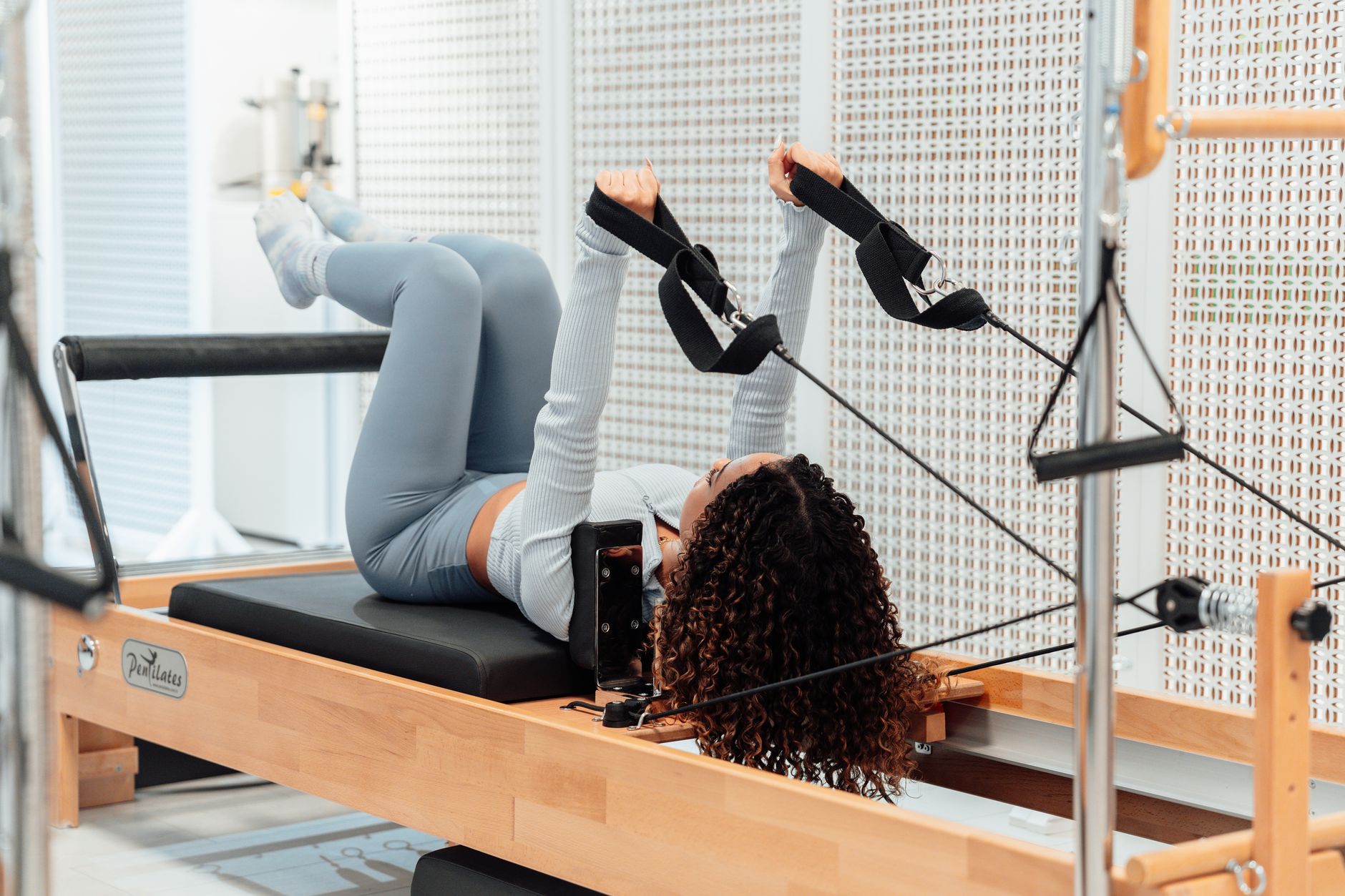
The Long Stretch looks like a plank. It isn’t. The moment the carriage starts moving, everything that was passively held has to become actively managed - and most people find out immediately that their shoulder girdle has been freeloading.
In Classical Pilates, the Long Stretch is part of the Stomach Massage and Knee Stretch series on the Reformer, though it stands apart from both in what it demands. The setup is deceptively simple: hands on the footbar, toes on the headrest platform, body in one long diagonal line. Then you push the carriage out and pull it back in, maintaining that line the entire time.
The work is in not letting anything negotiate.
What the Shoulders Are Actually Doing
The serratus anterior has to fire from the first moment your hands contact the bar. Without it, the scapulae wing, the thoracic spine sinks, and the “plank” becomes a hammock. What looks like a shoulder problem is usually a serratus problem - the shoulder blades aren’t being held against the ribcage, so the whole structure loses integrity before the carriage moves an inch.
The cue that tends to work: think about pushing the bar away from you, not just resting weight on it. That shift in intention recruits the right musculature. The bar doesn’t move, but your relationship to it does.
The Carriage Reveals Everything
Once the carriage is in motion, the body has to resist two competing forces - the springs pulling the carriage back in on the way out, and the temptation to collapse at the hips on the return. Most students drop their pelvis on the way in. The hip flexors shorten, the lumbar goes into extension, and the long line is gone.
This is where abdominal connection matters in a very specific way. It isn’t bracing. It’s a lengthening through the front of the body that counteracts the pull toward compression. Joe Pilates built the exercise to train the body to sustain length under load - not to hold a static shape, but to maintain organization while something is actively trying to disrupt it.
The spring resistance is usually light for this exercise, which fools people. Light springs mean less help on the return. The body has to do more, not less.
Why It’s Worth Getting Right
The Long Stretch is a diagnostic as much as it is an exercise. In a single rep, a teacher can see how a student manages their scapular stability, their spinal neutrality, their breath timing, and their relationship between the upper and lower body.
Students who’ve been doing it for years still find things to refine. That’s not a flaw in their training - that’s the exercise doing exactly what it was designed to do.