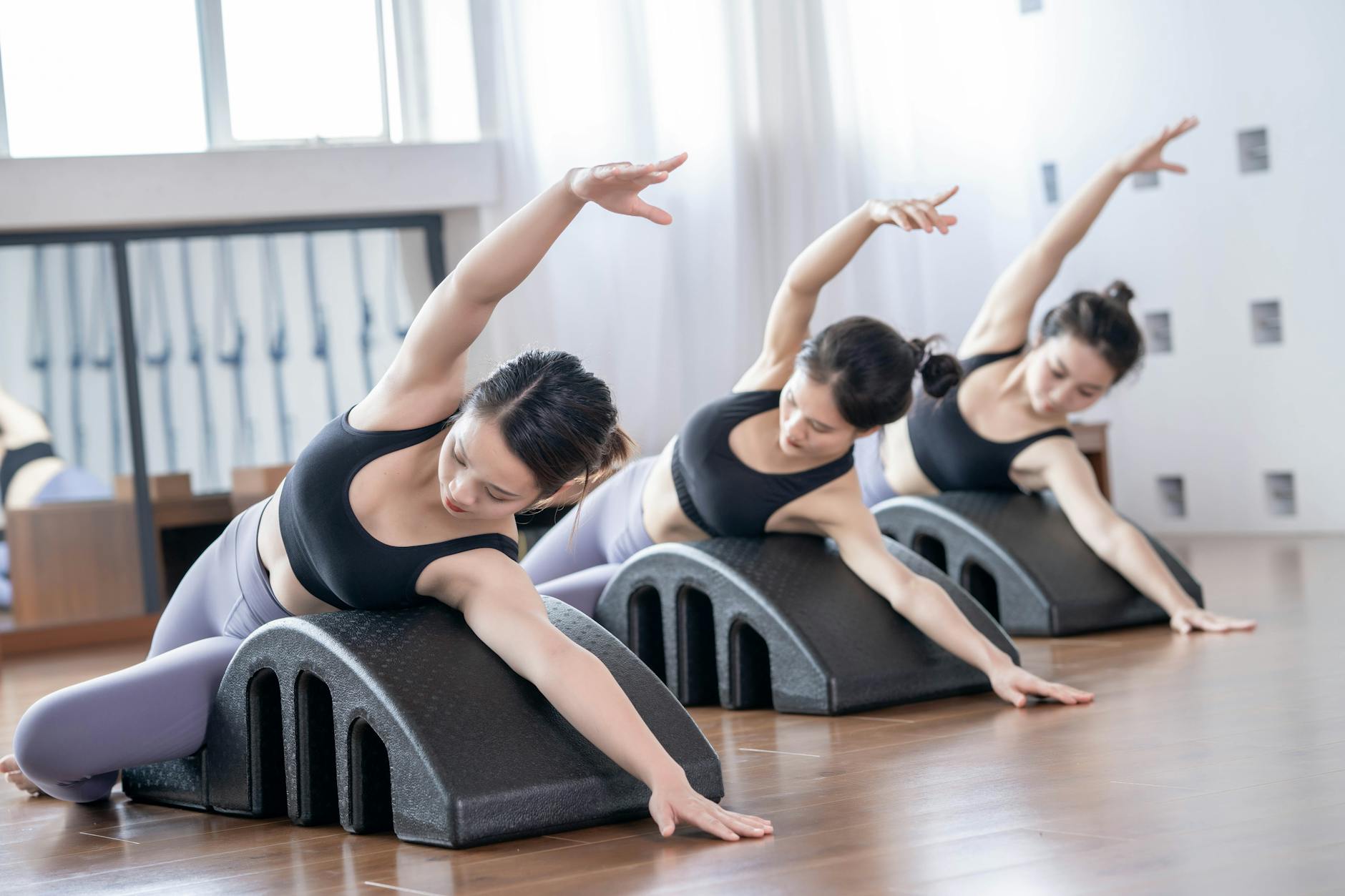
The Spine Corrector sits in most studios looking like a rest stop. Its rounded barrel, its soft foam, the way it cradles the lower back - none of that is an invitation to be passive. Joseph Pilates designed it as a corrective apparatus in the most demanding sense of the word: a tool that exposes what your spine actually does when it’s taken out of gravity’s usual arrangement and asked to move without the floor as a crutch.
Most people encounter it first through extension work, lying back over the barrel with arms reaching overhead. That’s the image. But the Spine Corrector’s real character shows up in exercises like the Cat, where you’re seated on the front lip of the barrel, feet planted, and you’re being asked to articulate every vertebra against a surface that follows your curve rather than flattening it. The barrel doesn’t correct you. You correct yourself on it.
What the Apparatus Actually Demands
The rounded top of the Spine Corrector creates an unstable base - not dramatically so, but enough that your deep stabilizers have to be present from the first breath. When you move into extension over it, the barrel supports the shape, which means your extensors can finally release and lengthen rather than gripping to protect a compressed lumbar. That release is the point. But it only produces something useful if you’re also working the abdominals to control how deep into the extension you go.
This is where the Spine Corrector separates itself from passive stretching apparatus. The Arm Circles performed on it require genuine scapular stability - the kind that doesn’t show up in shoulder circles done standing. The position changes the load. You feel work in the serratus anterior and the lower trapezius that a mat exercise in the same range simply won’t access the same way. The barrel creates the conditions; your nervous system has to meet them.
The Seated Work Is Underused
The exercises performed with the practitioner seated on the barrel - rather than draped over it - don’t get enough attention in group settings. Seated Cat, Seated Mermaid, the rotational variations: these put the pelvis in a position where compensation through the hip flexors is immediately visible. The barrel’s edge is unforgiving about pelvic instability in a way that a mat simply isn’t. If your pelvis rocks when it should be anchored, you know it.
One Specific Cue That Changes Everything
When a student lies back over the Spine Corrector for the first time and reaches the arms overhead, the instinct is to let the head drop and the ribs flare. The cue that reorganizes all of it: knit the ribs down before the arms move. Not after, not simultaneously - before. That sequencing asks the obliques to set the container first. Once that’s in place, the extension that follows is controlled rather than collapsed.
Without that sequence, you’re just draping yourself over foam. With it, you’re working.