
Wrist discomfort in Pilates is rarely a wrist problem. The wrist is the last link in a chain that starts at the shoulder girdle, runs through the forearm, and terminates at the heel of the hand. When that chain is disorganized upstream, the wrist absorbs what the shoulder refused to manage.
This shows up most clearly in the Long Stretch, the Down Stretch, and any variation of the Push-Up on the Reformer or Mat. The hands are planted, weight is loaded, and suddenly there is compression or aching at the base of the palm. The instinct is to adjust the hands - angle them out, pad the wrists, take the weight more on the fingers. None of that fixes the actual problem.
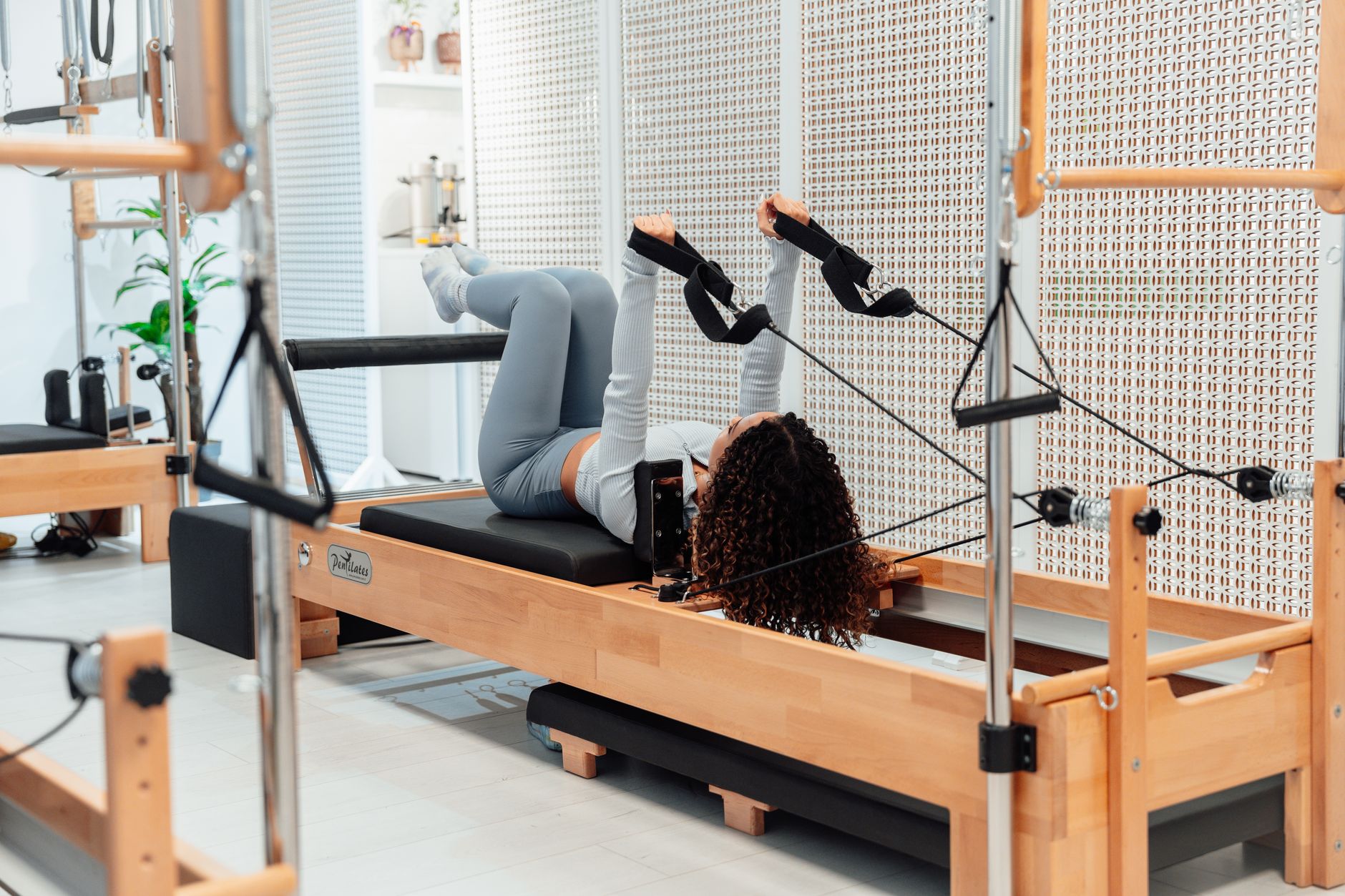
What the Shoulder Girdle Is Actually Supposed to Do
In any weight-bearing position on the hands, the scapulae need to stabilize against the rib cage while the shoulder joint simultaneously organizes into the socket. These are two separate actions that have to happen at the same time. Most people default to one or the other - either the scapulae are gripping so hard they elevate, or they’re completely passive while the humeral head drifts forward in the socket.
When the head of the humerus drifts forward, it shortens the anterior chain from shoulder to wrist. That shortening compresses the carpal tunnel and loads the wrist into extension before any actual movement has even started. The wrist is already working at a deficit before the legs push the carriage out.
The fix is proximal: draw the shoulder heads back and down, widen the collarbones, and feel the weight distribute through the entire palm - not just the heel of the hand. That redistribution is only possible if the shoulder is organized first.
One Specific Test
Before Long Stretch, place the hands on the foot bar and pause. Without moving anything else, check whether the elbows are softly pointing toward each other or splaying outward. Elbows splaying out usually signals external rotation collapse at the shoulder - the rotator cuff is not holding the head of the humerus in the socket. That alone will load the wrist.
Internal rotation of the upper arm (not gripping, just organizing) changes the entire picture.
The wrists are not fragile. They are informative. When they complain, the question to ask is not what to do with the hands but what the shoulder girdle has been avoiding.